




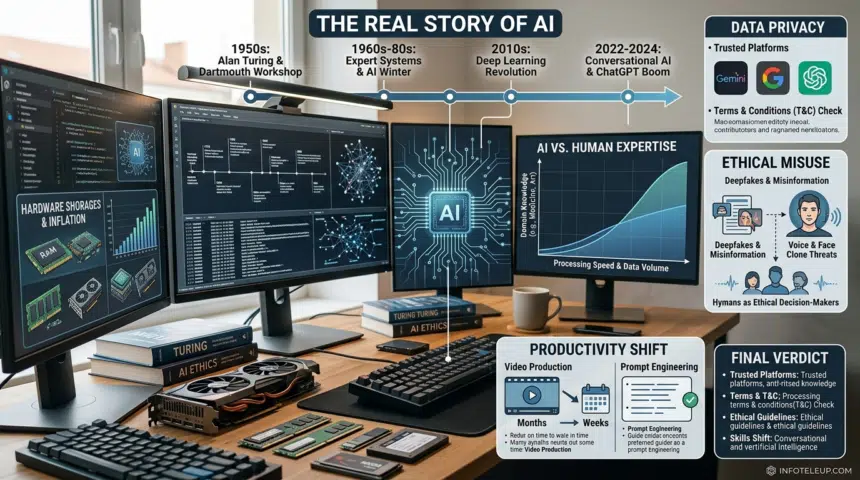
Artificial Intelligence (AI) has rapidly transformed from an academic curiosity into the foundational backbone of the modern digital economy. While the theoretical framework of machine learning has been developing for decades, the world experienced an unprecedented shift between 2022 and 2024. The public launch of large-scale generative models—such as Google Gemini, OpenAI’s ChatGPT, and advanced image generation platforms—catalyzed a global technological race.
- 1. The Historical Journey: From 1950 to the Generative AI Revolution
- 2. AI Data Privacy: Understanding Trusted Platforms vs. Data Leaks
- 3. The Dark Side: Deepfakes, Voice Cloning, and Human Ethics
- 4. AI Limitations: Why Human Disclaimers and Oversight Matter
- 5. The Job Replacement Myth: Did AI Take Jobs, or Did Skills Fail to Evolve?
- 6. Practical Real-World Uses: Compressing Months of Work into Weeks
- 7. The Hidden Supply Chain Crisis: RAM Shortages and Tech Inflation
- 8. Environmental and Resource Costs of Modern AI
- 9. Cognitive Risks: Over-Reliance and the Threat to Critical Thinking
- 10. Copyright Laws, Intellectual Property, and Fair Use Battles
- 11. How to Adapt: Step-by-Step Prompt Engineering Guide for Professionals
- 12. Future Outlook (2026–2030): Quantum AI, Autonomous Agents, and AGI
- Final Thoughts: Navigating the Future of Technology
However, as AI integration becomes universal across mobile operating systems, search engines, and enterprise software, public debate has intensified. Concerns regarding data privacy, job loss, deepfake propaganda, hardware supply chain crises, and ethical degradation have raised urgent questions. Is Artificial Intelligence a threat to human potential, or are we simply misdirecting our criticism away from human behavior and lack of adaptation?
This ultimate guide covers the origin of AI, its underlying infrastructure, data privacy frameworks, job displacement myths, ethical boundaries, and actionable strategies for leveraging AI effectively in a rapidly changing world.
1. The Historical Journey: From 1950 to the Generative AI Revolution
To understand the current state of artificial intelligence, it is essential to review the pivotal eras that shaped its architecture:
- The Foundations (1950–1956): British mathematician Alan Turing published his seminal work, “Computing Machinery and Intelligence,” proposing the Turing Test research to measure machine-simulated thinking. Shortly after, at the 1956 Dartmouth Conference, computer scientists Marvin Minsky, John McCarthy, Claude Shannon, and Nathaniel Rochester officially established the term “Artificial Intelligence.”
- Rule-Based Systems and First AI Winters: During the 1970s and 1980s, AI operated on hardcoded logic rules (if-then statements). These systems failed to handle real-world complexity, leading to severe funding cuts known as “AI Winters.”
- The Rise of Machine Learning & Neural Networks: By the late 1990s and 2000s, abundant internet data allowed algorithms to shift from static rules to statistical probability. Instead of being explicitly programmed, machines began learning patterns independently.
- The 2022–2024 Generative Hyper-Boom: The introduction of modern Transformer architectures enabled neural networks to understand context, human sentiment, and complex languages simultaneously. The period between 2022 and 2024 marked the transition of AI from specialized corporate data centers directly to millions of daily consumers.
2. AI Data Privacy: Understanding Trusted Platforms vs. Data Leaks
A recurring concern among users is whether AI tools secretly record, share, or expose sensitive personal data. The reality of digital privacy depends entirely on which platforms you use and how you handle your user settings.
Trusted Infrastructure vs. Unverified Wrappers
Major technology leaders operate under strict compliance standards (GDPR, CCPA, ISO security protocols). When interacting with established models like Google Gemini, user data is safeguarded by enterprise encryption. In contrast, free third-party apps or unverified AI wrappers often lack basic data protection layers, scraping user prompts for advertising networks or untrusted databases.
Reading Terms & Disclaimers
Before pasting private information, financial reports, or proprietary source code into an AI system, users should review platform terms:
- Opt-Out Policies: Most tier-one platforms allow users to disable prompt logging for model training.
- Local Session Security: Enterprise versions offer zero-data-retention environments where queries are erased immediately after generation.
- User Responsibility: Data leaks rarely happen because an enterprise AI was hacked; they occur when individuals input confidential data into public, unsecured interfaces without reading the privacy disclaimers.
To learn more about masking your network footprints and preventing online tracking, read our [complete online anonymity guide].
3. The Dark Side: Deepfakes, Voice Cloning, and Human Ethics
With voice cloning algorithms requiring only a few seconds of sample audio to replicate human inflection, and image generators producing photorealistic faces, malicious use cases have surfaced globally. Scams, impersonation, political propaganda, and non-consensual media creation are serious modern threats.
However, a fundamental distinction must be drawn: AI is an execution engine, not an ethical decision-maker.
   [ Unethical Human Intent ]
              │
              ▼
   [ AI Execution Engine ]  ──► (Voice Cloning / Deepfakes)
              │
              ▼
   [ Misuse Impact on Society ]
The Human Behavior Element
- Tools vs. Intention: A digital camera can be used to film a masterpiece or to conduct unauthorized surveillance. The camera itself remains ethically neutral. Similarly, AI voice cloning is a tool; executing a scam or spreading propaganda reflects human dishonesty and social engineering.
- Legal and Technical Safeguards: Fighting deepfakes requires robust digital media provenance protocols (such as C2PA cryptographic watermarks), stricter cybercrime enforcement, and enhanced public awareness—not halting computational progress.
4. AI Limitations: Why Human Disclaimers and Oversight Matter
Despite impressive processing power, current AI systems do not possess genuine consciousness, common sense, or real-world physical experience.
The Problem of Hallucinations
Generative AI operates on statistical prediction—calculating the most logical next word in a sequence. Because it prioritizes fluency over absolute truth, it can occasionally generate plausible-sounding falsehoods known as hallucinations.
High-Stakes Domains: Healthcare and Legal Realities
If a user requests a medical diagnosis from an AI model based on symptoms, the tool may provide general medical literature. However, it will always include a mandatory system disclaimer: “Consult a certified healthcare professional.”
Why? Because an AI cannot physically examine a patient, evaluate subtle diagnostic nuances, or assume legal liability for medical decisions. Human professionals bring critical real-world context that software cannot replicate.
+-----------------------------------------------------------------------+
|                       AI vs. Human Expertise                          |
+------------------------------------+----------------------------------+
| AI Capabilities                    | Human Expertise                  |
+------------------------------------+----------------------------------+
| High-speed data processing          | Emotional intelligence & empathy |
| Pattern recognition across datasets| Real-world physical context      |
| Rapid draft & code generation      | Ethical & legal accountability   |
| 24/7 continuous operation          | Strategic & abstract thinking    |
+------------------------------------+----------------------------------+
5. The Job Replacement Myth: Did AI Take Jobs, or Did Skills Fail to Evolve?
Following the 2022–2024 technology boom, many freelancers, copywriters, entry-level programmers, and digital graphic artists reported declining client orders. This triggered widespread claims that AI was destroying creative livelihoods.
However, analyzing market metrics reveals a clearer picture: AI does not eliminate skilled jobs; it highlights the gap between basic execution and true domain expertise.
The Domain Knowledge Gap (Prompting Mastery)
An AI tool relies entirely on the precision and expertise of the human operator. Consider how different users interact with generative software:
- The Basic User: Types “Draw a modern house.” The result is generic, uninspiring stock art.
- The Domain Expert (Architect/Interior Designer): Inputs “Render a Scandinavian architectural house, matte concrete exterior, double-height floor-to-ceiling glass, natural 4000K afternoon ambient light, minimal shadow noise, and 35mm lens depth-of-field.”
A professional photo editor understands color science, lighting angles, and compositions that a novice cannot articulate. A senior software developer understands system architecture and memory management that a beginner cannot prompt for. AI requires deep human domain knowledge to deliver professional results.
[ Untrained User Prompt ]  ──►  Generic / Low-Quality Output
[ Professional Prompt ]    ──►  High-Value / Client-Ready Result
The New Freelance Economy
Clients are no longer willing to pay high fees for generic content or basic manual labor that simple tools can generate. However, they actively hire AI-empowered professionals who can combine human creative direction with machine efficiency to deliver high-quality projects faster.
6. Practical Real-World Uses: Compressing Months of Work into Weeks
When implemented strategically, AI does not eliminate human input; it compresses execution timelines, eliminating creative burnout and redundant administrative overhead.
Case Study: Video & Media Production
- Traditional Workflow: Producing a complex, 1-hour documentary historically required months of frame-by-frame cuts, manual audio cleanup, color grading, manual transcription, and multi-day rendering queues.
- AI-Augmented Workflow: By using specialized neural tools for background noise isolation, automated timeline cutting, dynamic captions, and GPU-accelerated rendering, creators can complete that same documentary in a fraction of the time.
By automating repetitive production steps, creative teams can spend less time on routine technical tasks and more time refining storytelling and visual direction.
7. The Hidden Supply Chain Crisis: RAM Shortages and Tech Inflation
While AI operates in software, its execution depends on massive physical infrastructure. The sudden expansion of large language models has triggered severe friction in global hardware manufacturing.
Memory (HBM) and Component Strain
Training multi-billion parameter models requires specialized High Bandwidth Memory (HBM) and enterprise-grade Solid State Drives (SSDs). Semiconductor foundries have shifted manufacturing priorities away from consumer-grade desktop memory toward server racks.
       [ Semiconductor Foundries ]
                   │
         ┌─────────┴─────────┐
         ▼                   ▼
[ Enterprise HBM ]   [ Consumer RAM ]
  (High Priority)      (Supply Shortage)
         │                   │
         ▼                   ▼
 [ AI Data Centers ]  [ PC & Phone Price Inflation ]
Inflation in Consumer Hardware
Because chipmakers prioritize high-margin enterprise AI chips, raw component supply for everyday laptops, smartphones, and graphics cards faces structural shortages. This shift has contributed to rising prices across consumer electronics worldwide.
For a detailed breakdown of custom silicon and mobile chipset architecture, see our analysis on [next-gen mobile processors].
8. Environmental and Resource Costs of Modern AI
A critical aspect of the AI boom that is often overlooked is its environmental impact. Running global network servers requires unprecedented amounts of electricity and cooling resources.
- Power Grid Demands: Training a single large language model consumes gigawatt-hours of electricity—enough energy to power thousands of homes for an entire year.
- Water Consumption for Cooling: Massive data server racks generate immense heat, requiring millions of gallons of fresh water for cooling systems.
- The Push for Sustainable AI: Future developments must focus on energy-efficient chips and renewable-powered data centers to prevent straining global energy networks.
9. Cognitive Risks: Over-Reliance and the Threat to Critical Thinking
While productivity increases, excessive reliance on automated assistants introduces cognitive risks that users must actively manage:
- Intellectual Atrophy: Over-relying on automated tools for basic writing, simple math, or problem-solving can degrade human critical thinking skills over time.
- Loss of Originality: When creators accept default output without adding personal insight, digital content risks becoming repetitive and homogeneous.
- Maintaining Cognitive Engagement: Professionals should use AI as a digital assistant to generate drafts, perform proofreading, and synthesize research—while maintaining full ownership of analysis, strategy, and creative execution.
This danger is especially prominent in software development, where developers rely entirely on AI generation without understanding core code logic. To learn how automated code generation and reverse engineering impact modern engineering skills, read our in-depth report on [AI Reverse Engineering and Vibe Coding].
10. Copyright Laws, Intellectual Property, and Fair Use Battles
The explosion of generative AI has triggered major legal disputes worldwide regarding intellectual property:
- Data Scraping vs. Copyright: Millions of web pages, books, digital art, and code repositories were scraped to train foundation models. Original creators argue this constitutes copyright infringement, while tech firms defend it under fair use principles.
- Ownership of Output: Current legal standards in many jurisdictions hold that purely AI-generated content cannot be copyrighted. To secure legal ownership, human creators must demonstrate substantial creative modification and input.
11. How to Adapt: Step-by-Step Prompt Engineering Guide for Professionals
To stay competitive in an AI-driven market, professionals must learn how to write precise, high-context prompts.
+----------------------------------------------------------------------------------+
|                        The Perfect Prompt Formula                                |
|                                                                                  |
|  [ROLE] + [CONTEXT] + [SPECIFIC TASK] + [CONSTRAINTS] + [OUTPUT FORMAT]          |
+----------------------------------------------------------------------------------+
The 5-Part Prompt Formula:
- Assign a Persona (Role): Tell the AI who it should act as (e.g., “Act as a senior cybersecurity analyst…”).
- Provide Context: Explain the background (e.g., “We are reviewing internal network logs for a small business…”).
- Define the Exact Task: State clearly what needs to be done (e.g., “Identify unusual port activity and summarize potential threats…”).
- Set Clear Constraints: Specify what to avoid (e.g., “Do not use complex technical jargon; keep it clear for non-technical stakeholders…”).
- Format the Output: Request a structured structure (e.g., “Present the findings in a 3-column markdown table.”).
12. Future Outlook (2026–2030): Quantum AI, Autonomous Agents, and AGI
As we look toward the end of the decade, artificial intelligence will continue evolving beyond simple chatbots toward fully integrated autonomous agents.
[ Simple Chatbots ] ──► [ Autonomous Workflows ] ──► [ Quantum AI & AGI ]
   (Basic Q&A)            (Multi-Step Tasks)           (Complex Reasoning)
- Autonomous AI Agents: Future systems won’t just generate text; they will independently carry out multi-step workflows—such as booking travel itineraries, managing software deployments, or coordinating complex logistics.
- Quantum Computational AI: Combining quantum computing with neural networks will dramatically accelerate complex processing, enabling breakthroughs in molecular biology, drug discovery, and climate modeling.
- Artificial General Intelligence (AGI): The long-term goal of AI research remains AGI—systems capable of understanding, learning, and applying knowledge across diverse domains at a human-equivalent level.
Final Thoughts: Navigating the Future of Technology
Artificial Intelligence is neither an apocalyptic threat to human labor nor a flawless substitute for human intellect. It is a powerful technological utility.
The disruption observed between 2022 and 2024 proved that static workflows are vulnerable to automation. However, by selecting secure platforms, respecting ethical disclaimers, protecting personal data, and continually expanding specialized domain knowledge, human professionals can use AI to achieve unprecedented levels of efficiency, innovation, and career success. The future belongs to those who adapt.