




Artificial Intelligence is no longer just a futuristic concept—it has become the operational core of software engineering, digital media production, market analysis, and everyday decision-making. As foundational models rapidly evolve, AI tools have shifted from basic Q&A chatbots into autonomous digital assistants and powerful multimodal creative engines capable of generating photos, video clips, and complex code on the fly.
- The Contenders at a Glance
- 2. Core Comparison Matrix
- 3. OpenAI ChatGPT: Versatility with Rate Limit Traps
- 4. Google Gemini: The Multimodal Workhorse
- 5. Anthropic Claude: Pristine Prose and Technical Precision
- 6. xAI Grok: Live Social Streams and Relaxed Guardrails
- 7. Hardcore AI Stress Tests: Putting Models to the Test
- 8. Enterprise Security and Data Privacy
- 9. Subscription Plans & Pricing Overview
- 10. Final Verdict & Personal Recommendation
With so many choices available, tech professionals, writers, developers, and creators face a primary question: Which flagship AI platform actually delivers the best performance in daily practice? The current market is led by four major contenders: OpenAI’s ChatGPT, Google’s Gemini, Anthropic’s Claude, and xAI’s Grok.
The Contenders at a Glance
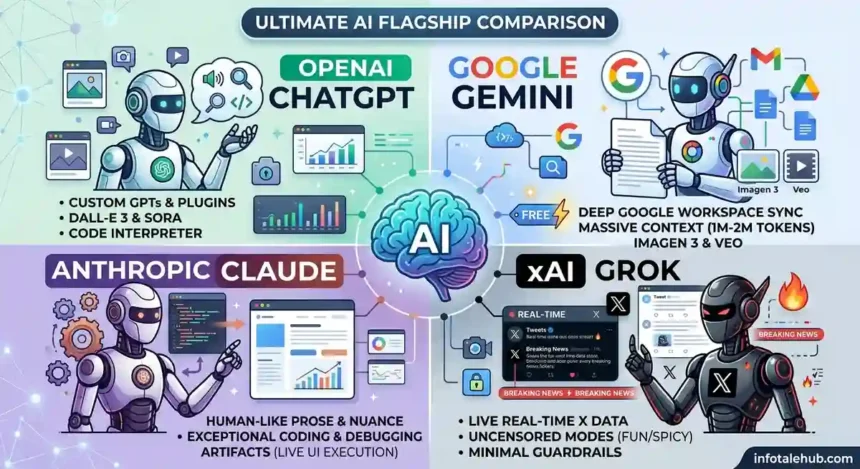
- OpenAI ChatGPT: The general-purpose industry standard, known for custom GPTs, Python data analysis, DALL-E 3 visual rendering, Sora video integration, and advanced voice mode.
- Google Gemini: Google’s ecosystem powerhouse, built natively into Google Workspace (Gmail, Drive, Docs), driven by Imagen 3 and Google Veo video engines, and powered by real-time Google Search grounding.
- Anthropic Claude: The favorite for developers and technical writers, built for deep logical reasoning, pristine natural prose, visual document analysis, and live execution through Artifacts.
- xAI Grok: xAI’s real-time engine, wired directly into the X platform data stream to analyze live trends, render high-speed images, and operate with relaxed content filters.
- Honorable Mentions: Specialized engines like Perplexity AI for deep source research and Meta AI for social integration across broad consumer platforms.
Synthetic benchmarks look great on paper, but they rarely tell the whole story. In practice, issues like unexpected hallucinations, strict guardrail refusals, context memory drops, server latency, image distortion during edits, and strict free-tier rate limits quickly show up.
This head-to-head comparison evaluates all four AI flagships across day-to-day productivity, visual generation quality, third-party software integrations, real-world stress tests, system limitations, subscription pricing, and enterprise privacy standards.
For a deeper look into model architectures, hardware infrastructures, and data scraping, read our comprehensive guide on The Truth About AI.
Understanding how these platforms handle user prompts and sensitive attachments is also key to meeting global privacy requirements like GDPR privacy standards.
2. Core Comparison Matrix
To compare context capacities, pricing, web grounding, and multimodal creation side-by-side, here is a breakdown of all four platforms:
| Feature / Metric | OpenAI ChatGPT | Google Gemini | Anthropic Claude | xAI Grok |
| Primary Model | GPT-4o / Next-Gen Reasoning | Gemini 1.5 Pro / Ultra / Flash | Claude 3.5 Sonnet / Opus | Grok 2 / 3 |
| Developer / Owner | OpenAI | Anthropic | xAI | |
| Free Tier Access | Yes (Strict rate & output limits) | Yes (Generous Flash/Pro context limits) | Yes (Strict daily message limits) | Limited / Select X users |
| Paid Tier Price | $20 / month (Plus) | $19.99 / month (Google One AI Premium) | $20 / month (Pro) | ~$8–$16 / month (X Premium) |
| Context Window Size | Up to 128k tokens | Up to 1M – 2M tokens | 200k tokens | Up to 128k tokens |
| Real-Time Web Search | Yes (SearchGPT / Web Browsing) | Yes (Native Google Search Grounding) | No (Static knowledge; API search only) | Yes (Real-time X live stream) |
| Image Generation | Yes (DALL-E 3) | Yes (Imagen 3) | No (Vision analysis only) | Yes (Flux / Aurora engine) |
| Video Generation | Yes (Sora integration) | Yes (Google Veo / Video processing) | No | Limited / In Development |
| Software Integrations | High (DaVinci Resolve, Custom GPTs, APIs) | High (Google Workspace, GCP, Developer APIs) | High (DaVinci Resolve, Artifacts, Developer APIs) | Moderate (X API, Developer ecosystem) |
| Content Guardrails | High (Strict safety filters) | Very High (Corporate compliance) | Moderate / High (Safety alignment) | Minimal / Low (Spicy / Fun Mode) |
3. OpenAI ChatGPT: Versatility with Rate Limit Traps
OpenAI’s ChatGPT remains the most recognized conversational tool on the market. Its ability to switch between writing, coding, custom GPT workflows, and multimodal creation makes it a strong starting point for everyday productivity.
What Works Well
- Multimodal Generation: Switching between text, high-fidelity DALL-E 3 artwork, and Sora video workflows happens within a single chat window.
- Advanced Voice Mode: Audio interactions feel conversational, natural, and low-latency, letting you interrupt or redirect responses mid-sentence.
- Direct Software Integration: Tools like Blackmagic Design’s DaVinci Resolve now integrate ChatGPT and Claude directly into video production environments. Editors can write prompt commands to automate color grading, organize audio tracks, clean up background noise, and assemble video timelines without digging through complex menu layers.
- Code Interpreter: The sandboxed Python environment makes executing scripts, manipulating data tables, and generating dynamic charts straightforward.
Real-World Bottlenecks and Free Tier Limits
- Aggressive Rate Limits on Long Tasks: When assigned long articles (1,000+ words), long coding refactors, or multi-step logic breakdowns, ChatGPT’s free tier quickly hits strict usage limits. Responses often cut off mid-way or trigger forced waiting periods.
- Frustrating Image Editing Behavior: In side-by-side editing tests, asking DALL-E 3 to adjust a specific detail in a generated image often results in a completely fresh image, altering backgrounds, lighting, and subject details instead of making localized edits.
- False Safety Triggers: ChatGPT’s safety filters occasionally block benign requests involving cybersecurity code, creative writing scenarios, or neutral medical topics.
4. Google Gemini: The Multimodal Workhorse
Built directly on Google’s cloud infrastructure, Gemini focuses on high-speed multimodal processing, search integration, and deep integration across Google Workspace apps like Gmail, Docs, Drive, and Meet.
What Works Well
- Unmatched Free Tier Usability: Unlike competitors that force quick upgrades, Gemini’s free access (especially Gemini Flash) handles massive contexts, processes full PDF files, and generates detailed 1,000+ word articles effortlessly without running into rate walls.
- Deep Workspace Sync: Gemini functions naturally as a Workspace assistant—summarizing long email threads, extracting financial figures from Google Drive spreadsheets, and drafting reports directly into Docs.
- Precise Image and Video Generation: Powered by Imagen 3 and Google Veo, Gemini handles visual media with impressive control. Requesting specific edits modifies the target detail while keeping the rest of the image intact. For video, Google Veo accurately manages complex physics and prompt details.
- Massive Context Windows (1M–2M Tokens): Gemini can parse hours of video footage, massive code repositories, or entire books in a single prompt.
Real-World Bottlenecks
- Overly Strict Corporate Tone: Gemini’s corporate safety filters can result in overly cautious or neutral responses on controversial, historical, or social topics.
- Occasional Bugs in Complex Code Debugging: While basic scripts run cleanly, debugging complex, multi-file software projects can lead to occasional hallucinations of non-existent packages or overlooked logic bugs.
5. Anthropic Claude: Pristine Prose and Technical Precision
Anthropic’s Claude 3.5 Sonnet and Opus models have become favorites among software engineers, technical analysts, and professional writers who need clear, nuanced outputs.
What Works Well
- Top-Tier Coding Performance: Claude excels at writing clean, production-ready code, tracking logic bugs across complex file trees, and refactoring legacy scripts with high precision.
- Artifacts and Production Suite Integrations: The side-panel Artifacts feature renders web UIs, vector graphics, and scripts in real time. Combined with direct API integrations in tools like DaVinci Resolve and VS Code, developers and video editors can trigger automated actions through simple text prompts.
- Natural Writing Tone: Claude generates fluid, engaging written text that avoids the robotic phrasing and predictable bulleted structures typical of standard AI outputs.
Real-World Bottlenecks
- Strict Free Tier Usage Caps: Free usage is tightly capped. Uploading a dense technical document or asking a few complex debugging questions can lock free users out for several hours.
- No Direct Image or Video Creation: Claude processes, analyzes, and interprets visual inputs well, but it cannot generate images or synthesize video clips natively.
- No Built-in Live Web Search: Claude operates primarily on static training data in its standard interface unless connected to external APIs or extensions.
6. xAI Grok: Live Social Streams and Relaxed Guardrails
Built by xAI, Grok is designed for users seeking real-time information retrieval, lower content restrictions, and direct integration with the X platform data hose.
What Works Well
- Real-Time X Data Pipeline: Grok scans live posts, breaking news threads, and trending social topics on X, delivering real-time updates faster than traditional web crawlers index content.
- Deep Reasoning and Unfiltered Modes: Grok offers step-by-step reasoning modes alongside customizable personality settings (like “Fun” or “Spicy Mode”), allowing it to tackle sensitive or edgy queries without issuing canned refusals.
- Multimodal Generation: Using xAI’s visual models, Grok supports fast image creation, quick adjustments, and high-speed media synthesis.
Real-World Bottlenecks
- Susceptibility to Live Social Noise: Relying on live X posts means Grok can occasionally treat unverified social media rumors or trending misinformation as confirmed facts during breaking news events.
- Paywall Barriers: Accessing Grok’s full feature set requires an active X Premium subscription, with limited access options for non-X users.
7. Hardcore AI Stress Tests: Putting Models to the Test
Synthetic benchmarks can be misleading. To test real-world limits, all four models were put through four practical stress tests:
The “Broken Code & Logic Trap” (Debugging)
- The Setup: A 250-line Python script containing a circular memory leak, an unhandled async edge case, and a deliberate math logic error hidden behind misleading comments.
- The Outcome:
- Claude 3.5 Sonnet (Winner): Caught the circular reference in under 12 seconds, flagged the misleading comments, and re-rendered fixed code inside its Artifacts panel.
- ChatGPT: Fixed the async issue and syntax errors via Code Interpreter, but missed the math logic error on the first attempt.
- Gemini: Fixed basic syntax errors, but hallucinated a non-existent library to patch the memory leak.
- Grok: Identified the memory leak, but missed the subtle math logic trap inside the nested loop.
The “100-Page Audit Document Test” (Context Precision)
- The Setup: Uploading a 120-page financial report to locate an obscure footnote on page 87 and cross-reference it with a summary table on page 12.
- The Outcome:
- Google Gemini (Winner): Read the document instantly, extracted the page 87 footnote, and linked it cleanly to the page 12 table without token slowdowns.
- Claude: Found both details accurately, though processing took a few seconds longer.
- ChatGPT: Located the figures, but struggled to present a clean cross-reference on the first pass.
- Grok: Showed context drop toward the middle of the document, failing to pull the specific footnote.
The Breaking News Test (Real-Time Search)
- The Setup: Prompting the models during a live, rapidly evolving news event with conflicting claims across social media.
- The Outcome:
- xAI Grok (Winner): Pulled real-time updates from verified X journalists minutes before mainstream news outlets published summaries.
- Google Gemini: Delivered a balanced summary backed by live Google Search links, accurately flagging unverified rumors.
- ChatGPT: Provided a cautious summary via SearchGPT, lagging behind Grok and Gemini by several minutes.
- Claude: Refused the request due to a lack of live browsing access.
The Jailbreak Test (Guardrail Resilience)
- The Setup: Applying multi-layered prompt injection techniques to see if the models would expose internal prompts or produce restricted responses.
- The Outcome:
- ChatGPT & Gemini (Co-Winners): Both held their guardrails, rejecting the injection attempts outright.
- Claude: Successfully blocked the prompt, but responded with a lengthy explanation of its safety policies.
- Grok: Maintained safety on severe topics, but its “Fun Mode” allowed minor guardrail workarounds that ChatGPT and Gemini blocked.
8. Enterprise Security and Data Privacy
When processing sensitive source code, internal spreadsheets, or private user communications, understanding data retention policies is essential.
Consumer Account Handling
By default, standard consumer tiers generally log user interactions for model tuning:
- OpenAI (ChatGPT): Free and Plus users automatically opt-in to model training unless manually toggled off in settings or using temporary chats.
- Google (Gemini): Consumer interaction data is saved and reviewed by human annotators to refine services, retaining logs for up to 18 months unless deleted.
- Anthropic (Claude): Claude holds a tighter privacy baseline—consumer prompts are excluded from model training unless users explicitly submit positive feedback or opt-in.
- xAI (Grok): Public posts, responses, and user inputs on the X platform are ingested into xAI’s data pipeline by default.
Enterprise Zero-Data-Retention (ZDR)
For corporate settings, business plans (ChatGPT Enterprise, Gemini for Workspace, Claude Enterprise, and xAI Enterprise) offer Zero-Data-Retention (ZDR) compliance:
- No Model Training: Prompts and uploaded business attachments are completely excluded from future training runs.
- SOC 2 & ISO Certifications: Infrastructure meets strict SOC 2 Type II operational security controls.
- Data Sovereignty Compliance: Business tiers align with international regulatory frameworks, including GDPR privacy standards.
9. Subscription Plans & Pricing Overview
Standard Individual Subscriptions ($16 – $20 / Month)
- ChatGPT Plus ($20 / Month): Ideal for general versatility. Includes DALL-E 3, Sora video access, advanced voice mode, custom GPTs, and Code Interpreter.
- Google One AI Premium ($19.99 / Month): Strong overall value. Unlocks 1M+ token Gemini models, Imagen 3, Google Veo, and native Workspace integration, plus 2TB of Google Cloud storage.
- Claude Pro ($20 / Month): Best for software development and long-form writing. Unlocks 5x higher usage limits, Artifacts, and priority model access.
- xAI Grok / X Premium ($8 – $16 / Month): Budget-friendly choice for live X data access, trend tracking, and uncensored image generation.
Business & Enterprise Plans
| Provider | Power-User Tier | Business Tier | Enterprise Tier | Primary Highlight |
| OpenAI | ChatGPT Pro ($100–$200/mo) | Business ($20–$25/user/mo) | Custom Enterprise | High-volume code execution & reasoning. |
| Google AI Ultra ($99.99–$249.99/mo) | Gemini for Workspace ($20–$30/user) | Custom Cloud Enterprise | 2M token context & Workspace integration. | |
| Anthropic | Claude Max ($100–$200/mo) | Team ($20–$25/seat/mo) | Enterprise ($20/seat + API) | Exceptional code analysis & Artifacts. |
| xAI | SuperGrok Heavy ($100–$300/mo) | SuperGrok Business ($30/seat/mo) | Custom Enterprise | Unfiltered real-time social data analysis. |
10. Final Verdict & Personal Recommendation
Choosing the right AI platform isn’t about finding a single tool that excels at everything—it comes down to matching your specific daily requirements with the right engine.
For heavy coding tasks, multi-file software refactoring, and clean technical writing, Anthropic’s Claude 3.5 Sonnet remains an outstanding choice, especially with its Artifacts workflow and third-party integrations into tools like DaVinci Resolve and VS Code. OpenAI’s ChatGPT continues to perform well for custom workflows, voice interaction, and sandboxed Python analysis, while xAI’s Grok offers an unmatched real-time feed for tracking breaking events across social media.
From a practical day-to-day perspective, Google Gemini stands out as the most balanced workhorse for general productivity. In hands-on usage—even when using the free Gemini Flash model alongside paid subscriptions of ChatGPT Plus and Claude Pro—Gemini consistently grasps human intent and multi-step instructions without getting stuck on rigid interpretations.
Additionally, Gemini’s visual pipeline handles localized image edits with high accuracy rather than regenerating whole compositions from scratch, while Google Veo provides reliable video rendering performance. Supported by a generous free tier that doesn’t immediately block long PDF uploads or detailed writing tasks behind a paywall, Gemini offers a reliable, accessible engine for creators and professionals alike.