




Introduction: The Growing Thermal Debate Around Snapdragon
The mobile processor industry moves at an extremely fast pace every single year. Qualcomm has long dominated the flagship Android smartphone market with its powerful Snapdragon chipsets. However, a troubling trend has emerged among users and tech critics worldwide. Modern mobile devices powered by recent high-end chips frequently suffer from severe thermal throttling and excess heat generation.
- Introduction: The Growing Thermal Debate Around Snapdragon
- Qualcomm and Samsung: A Partnership Under Thermal Strain
- Real Tech Reviewer Insights: Test Crashes & 3DMark Stress Tests
- Understanding the Root Cause of Mobile Overheating
- The Real-World Impact on Mobile Gamers & Heavy Users
- Competitor Pressure: Are MediaTek and Apple Gaining Ground?
- Battery Drain and Long-Term Hardware Degradation
- How Qualcomm Can Win Back Consumer Trust
- Final Verdict: Is Qualcomm Actually Losing the Race?
If you want to understand how modern silicon handles intense thermal loads, check out our Next-Gen Mobile Processors Real-World Comparison. For video proof and independent hands-on testing on retail units, you can watch the RedMagic 12 Pro+ Thermal Review.
When your phone becomes too hot during routine multitasking or basic gaming, user experience drops dramatically. Many retail customers and tech enthusiasts now ask a critical question. Is Qualcomm losing its competitive edge in the mobile processor race? Let us examine the root causes, real-world impacts, and market shifts happening right now.
Qualcomm and Samsung: A Partnership Under Thermal Strain
The relationship between Qualcomm and Samsung highlights the severity of these heating challenges. Samsung relies heavily on customized Snapdragon chips for its flagship Galaxy Ultra lineup. However, recent internal testing reports revealed concerns over chip temperatures under sustained workloads.
Samsung reportedly issued warnings regarding chip thermal management for future flagship orders. If Qualcomm fails to resolve these severe overheating issues, Samsung will likely pivot completely to alternate silicon options. For a deeper breakdown of this partnership strain, read our analysis on the Samsung vs Qualcomm Clash for the S27 Ultra. This growing friction proves that chip heating is no longer just a minor defect; it directly threatens major industry partnerships.
Real Tech Reviewer Insights: Test Crashes & 3DMark Stress Tests
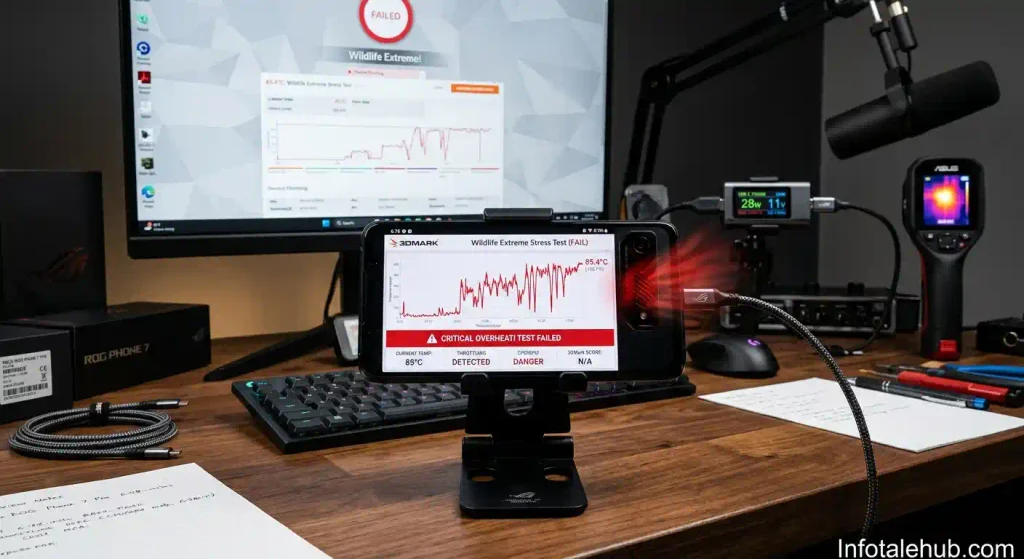
Tech reviewers and YouTubers testing early retail units have uncovered concerning stability benchmark failures. Independent stress tests, including 3DMark Wild Life Extreme, reveal severe performance degradation within minutes of heavy load. For a visual demonstration of these benchmark limits on flagship hardware, check out the OnePlus 16 Thermal and Gaming Review.
- 3DMark Test Failures & Thermal Shutdowns: Multiple reviewers report that the 3DMark Wild Life Extreme stress test completely crashes or aborts mid-run due to extreme thermal limits.
- Forced Cooling Required for Benchmarks: Testers often cannot complete stress runs in High Performance mode without external cooling fans or air-conditioned environments to force completion.
- Extremely Low Stability Scores: When tests finish, stability scores hover between 20% and 30%. Baseline figures like 25% show severe thermal throttling under sustained loads.
- Beyond Early Software Bugs: Defenders attribute these drops to unoptimized early firmware. However, hardware launches rarely suffered mid-test thermal shutdowns on retail-ready builds.
- Massive Battery Drain: High-capacity 8000mAh and 9000mAh batteries drain rapidly under continuous processor stress. Heat forces aggressive power consumption during heavy tasks.
- Severe In-Game Stuttering: Sustained gaming triggers frame drops, severe lagging, and high thermal buildup. High raw benchmark scores mean very little when real-world performance degrades so fast.
Understanding the Root Cause of Mobile Overheating
Thermal management remains one of the hardest engineering challenges in modern smartphone design. Phone manufacturers want thinner chassis profiles, brighter displays, and console-quality mobile gaming. Packing extreme processing power into a pocket-sized glass sandwich creates massive thermal density.
When peak clock speeds spike, energy inefficiency triggers rapid heat buildup. Qualcomm pushes raw performance limits to beat benchmark records every single year. Unfortunately, this aggressive pursuit of high clock speeds often compromises sustained thermal stability. Users notice that phones get uncomfortably warm during video recording, GPS navigation, and heavy web browsing sessions.
The Real-World Impact on Mobile Gamers & Heavy Users
Mobile gaming pushes processors harder than almost any other daily application. Games demand continuous high-frequency performance from both the CPU and GPU.
When a smartphone chipset reaches critical thermal thresholds, the system steps in to protect the internal hardware. This protective mechanism is called thermal throttling. It aggressively drops performance clocks to lower the temperature.
Gamers experience sudden frame drops, stuttering gameplay, and severe touch latency. Consumers spending top dollar on flagship devices expect stable peak performance without sudden thermal slowdowns.
Competitor Pressure: Are MediaTek and Apple Gaining Ground?
For many years, Qualcomm held an undisputed monopoly over high-end Android performance. Competitors like MediaTek historically struggled with thermal efficiency and software optimization in Western markets. However, the landscape has changed dramatically over recent hardware generations.
MediaTek’s Dimensity processors have made massive strides in power efficiency and sustained multi-core performance. Many flagship devices now prefer MediaTek chips because they run cooler and maintain better battery efficiency during extended tasks.
Meanwhile, Apple’s custom A-series silicon continues to dominate single-core efficiency and thermal management standards. Qualcomm can no longer afford to rely solely on raw marketing benchmark scores while thermal complaints pile up in global consumer forums.
Battery Drain and Long-Term Hardware Degradation
Excessive heat does not just ruin your immediate user experience; it actively harms the smartphone over its lifespan. Heat is the number one enemy of lithium-ion smartphone batteries. When a processor runs consistently hot, the internal battery chemistry degrades at an accelerated rate.
Users notice that daily screen-on time drops significantly after just six months of heavy usage. Furthermore, constant thermal stress can shorten the overall lifespan of internal storage and motherboard components. Retail store owners often hear complaints from customers whose phones lose battery health prematurely due to recurring heating cycles during charging and gaming.
How Qualcomm Can Win Back Consumer Trust
To stay ahead in this fiercely competitive race, Qualcomm must shift its primary engineering focus. Chasing raw benchmark numbers at the cost of thermal efficiency is no longer sustainable for daily smartphone users.
Future chipset architectures must prioritize sustained performance over short burst performance spikes. Better vapor chamber integration, smarter AI thermal governors, and improved node manufacturing partnerships will be vital. Brands that successfully deliver cool, stable, and efficient performance will capture consumer loyalty in the upcoming smartphone generations.
Final Verdict: Is Qualcomm Actually Losing the Race?
Qualcomm is not completely out of the race yet, but warning bells are ringing loudly. Their engineering talent remains top-tier, and their modem technology is still industry-leading.
However, recurring overheating issues across multiple device generations have damaged consumer trust. If they fail to solve sustained thermal management soon, rival semiconductor companies like MediaTek will capture even more market share in both flagship and mid-range segments. The next few hardware cycles will decide whether Qualcomm can reclaim its undisputed crown or fall behind permanently!