



Introduction: My Personal Story with the “TikTok Earning” Illusion
A while ago, I joined a Facebook group centered around a trending topic: “TikTok Earning & Monetization.” Living in an Asian country where the TikTok Content Creator Rewards Program is not officially supported, I was genuinely excited. The idea of earning dollars simply by uploading short videos sounded like an incredible opportunity.
- Introduction: My Personal Story with the “TikTok Earning” Illusion
- The Core Myth: Why a VPN Is Never Enough
- 5 Ways TikTok Actually Detects Your True Location
- 1. SIM Card MCC / MNC Detection
- 2. Hardware & Device Fingerprinting
- 3. System Locale, Timezones & GPS
- 4. Known VPN & Residential Proxy IP Databases
- 5. Advanced Packet Inspection (MTU/TTL & Latency Checks)
- The Consequences: Zero Views, Shadowbans & Disqualification
- The Ultimate Barrier: SSN, ITIN & Tax Verification Fraud
- The Hidden Trap of Android Emulators (BlueStacks, LDPlayer, Nox)
- The Solution: Stop Wasting Time & Become a Legit Content Creator
- 1. Build an Account in Your Local Region
- 2. Focus on Original, High-Value Content
- 3. Become a Trendsetter
- 4. Monetize Through Alternative Channels
- Conclusion
Driven by curiosity, I conducted deep research to understand how monetization worked. I quickly realized that TikTok’s Creator Rewards Program was restricted to specific European and North American regions (like the US and UK). However, inside these online communities and social media groups, people were actively promoting a shortcut: “Just turn on a VPN, bypass the system, and start earning USD from your home country.”
Although using virtual locations to trick a global platform is ethically and technically questionable, I was intrigued. To test the process, I had someone create a UK-based TikTok account for me using a VPN setup. They even went as far as linking a virtual UK phone number to the account. At first glance, it felt like a seamless bypass—as if TikTok’s backend could easily be fooled by a foreign number and a modified IP address.
Like millions of content creators across Asia today, I initially fell into the trap of believing that clearing browser cookies, switching to a fresh mobile device, or using a paid VPN/proxy would trick the platform.
The Harsh Reality: Fooling Yourself, Not TikTok
Here is the truth every creator needs to understand: You are not tricking TikTok; you are only wasting your valuable time.
TikTok’s backend security and fraud detection systems are far more advanced than a basic IP mask. While you might manage to create an account, the algorithm continuously evaluates hundreds of hardware and network signals. Before you even reach the payout threshold, your account is hit with silent shadowbans, zero views, or permanent disqualification from the monetization program.
The Core Myth: Why a VPN Is Never Enough
To understand why VPNs fail, you first need to understand how a Virtual Private Network works. A VPN creates an encrypted tunnel between your device and a remote server, effectively masking your public IP (Internet Protocol) address.
While this works for unblocking basic websites, modern platforms like TikTok do not rely on IP addresses alone, following digital tracking guidelines documented by the [Electronic Frontier Foundation privacy research].
- IP Address (Temporary): Dynamic and location-dependent. You can change it in seconds using a proxy or VPN.
- Device Identity (Permanent): Your hardware, operating system parameters, SIM card network information, and background settings create a permanent, unique digital fingerprint.
When you attempt to trick TikTok using a VPN, you are only altering the temporary network layer while leaving all permanent device parameters completely exposed.
5 Ways TikTok Actually Detects Your True Location
TikTok’s fraud prevention systems use multi-layered checks to verify creator authenticity:
1. SIM Card MCC / MNC Detection
Even if your phone is connected to a US VPN, your physical device contains a SIM card issued by a local telecom provider.
- MCC (Mobile Country Code): Identifies your country.
- MNC (Mobile Network Code): Identifies your specific cellular carrier.
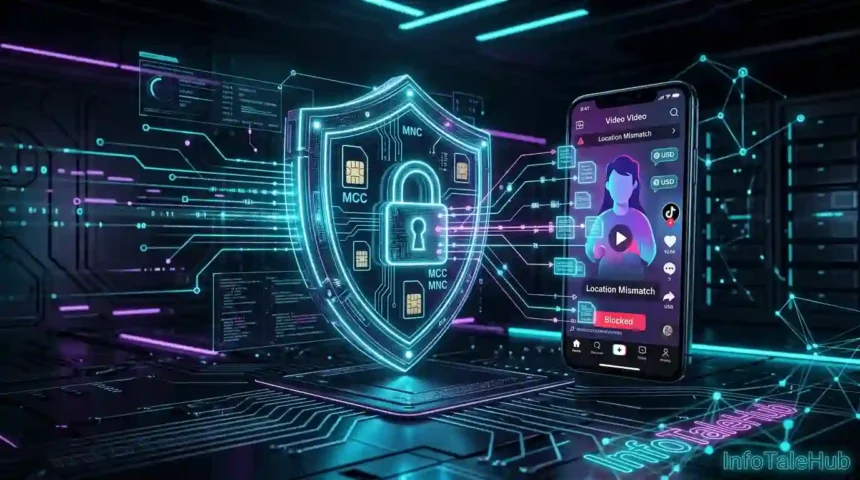
When the TikTok application initializes, it directly queries the device’s Telephony API to read the SIM card’s MCC and MNC parameters. If your IP address claims to be in New York (US) but your SIM card reports a local Asian MCC, the platform instantly flags the account for Location Mismatch & Fraud. Removing the SIM card completely doesn’t help either—a lack of cellular telemetry on a primary mobile phone triggers a high-risk security score.
2. Hardware & Device Fingerprinting
Every smartphone possesses unique hardware parameters compiled into a hash known as a Device Fingerprint:
- Android ID / IDFV (Identifier for Vendors)
- Build serial numbers and IMEI parameters
- Screen resolution, GPU renderer, and battery status API
- Installed system fonts and audio hardware configurations
When you create multiple accounts on the same phone—even after clearing app data, cache, or re-installing—TikTok recognizes the underlying hardware fingerprint.
3. System Locale, Timezones & GPS
- If your VPN IP shows
GMT-5(New York), but your system clock is set to local time (GMT+5), the mismatch is logged immediately. - System language settings, keyboard input layouts, and background Wi-Fi access point scanning continuously broadcast your true geographic vicinity.
4. Known VPN & Residential Proxy IP Databases
TikTok subscribes to enterprise IP intelligence services such as [MaxMind IP intelligence] to maintain real-time lists of data center IP ranges.
5. Advanced Packet Inspection (MTU/TTL & Latency Checks)
VPN encryption alters the Maximum Transmission Unit (MTU) size of internet packets (dropping from standard 1500 bytes to around 1380 bytes). Furthermore, network response time (Ping/Latency) from Asia to US servers is naturally higher (200ms+). High latency paired with a US IP address instantly reveals remote VPN routing.
For a deeper technical deep-dive into masking your network identity, check out our [complete online anonymity guide].
The Consequences: Zero Views, Shadowbans & Disqualification
Many creators ask: “If TikTok knows I’m using a VPN, why doesn’t it ban my account immediately?”
The system is designed to analyze account behavior before taking action. Here is how the trap unfolds:
- Initial Illusion (200–300 Views): When you first post, the algorithm gives you a baseline audience of 200–300 views and a few likes to analyze performance while background security checks run.
- The Shift to Zero Views: After 5 to 6 video uploads, as algorithms confirm that your hardware and SIM data consistently originate from a unsupported region, your account enters the Zero-View Glitch / Shadowban / Account Freeze.
- The Fake Engagement Trap: Desperate creators often buy fake bot views or panel engagement to force their way into monetization requirements. This secondary violation triggers automated fraud filters, placing the account into Permanent Monetization Disqualification.
The Ultimate Barrier: SSN, ITIN & Tax Verification Fraud
Even if an account miraculously bypasses initial filters and accumulates earnings, creators hit an insurmountable wall during payout verification:
- Regional Financial Requirements: Accounts registered in the US or UK require local bank accounts or region-verified PayPal accounts.
- SSN / ITIN Identity Fraud: Sellers on social media platforms often sell stolen or duplicate Social Security Numbers (SSN) or Individual Taxpayer Identification Numbers (ITIN).
- Payout Lockdowns: During payment processing, TikTok enforces strict identity checks requiring government-issued IDs and matching tax records. When duplicate tax identifiers or proxy locations are flagged, funds are permanently frozen and the account is terminated.
The Hidden Trap of Android Emulators (BlueStacks, LDPlayer, Nox)
Many creators attempt to manage monetization accounts from a PC using desktop Android emulators such as BlueStacks, LDPlayer, or Nox Player, believing that configuring a virtual Samsung or Xiaomi profile is sufficient to spoof a mobile environment.
+-----------------------------------------------------------------------+
|                   EMULATOR VS. PHYSICAL DEVICE DETECTION               |
+-----------------------------------------------------------------------+
| Feature            | Android Emulator          | Physical Phone       |
+--------------------+---------------------------+----------------------+
| Hardware Profile   | Virtualized (x86/x64)     | Native ARM / ARM64   |
| GPU Drivers        | OpenGL / DirectX Wrapper  | Adreno / Mali / Apple|
| Build Properties   | QEMU / VirtualBox Strings | OEM Signed Build     |
| Real SIM Status    | Missing / Emulated Dummy  | Physical Baseband    |
| Risk Level         | HIGH (Permanent Ban)      | SAFE (Compliant)     |
+--------------------+---------------------------+----------------------+
Why TikTok Easily Identifies Emulators
- Virtual Machine Architecture & GPU Emulation: Emulators run Android on top of desktop x86/x64 processor architectures using translation layers. TikTok’s native libraries inspect low-level system properties (
/system/lib/, build properties, OpenGL rendering strings, and CPU instruction sets). When rendering wrappers like VirtualBox or QEMU are detected, the device profile is instantly categorized as a Virtual Machine. - Hardcoded Device Fingerprints: While emulators allow users to change the visible model name in settings, they cannot fully replicate unique hardware signatures, baseband versions, or physical battery/sensor metrics.
- Consequences of Using Desktop Emulators:
- 0-View Limit: Uploads performed via emulators are automatically filtered out of the “For You” feed (FYP).
- Permanent Account Freezes: The account is flagged for “Automated or Synthetic Activity.”
- Payout Rejections: Accounts created or maintained via emulators fail compliance audits during Identity Verification (Tax/ID submitting) or withdrawal requests.
The Solution: Stop Wasting Time & Become a Legit Content Creator
Navigating through VPNs, clearing caches, buying virtual numbers, and purchasing fake SSNs requires immense effort—only to end in zero earnings and suspended accounts.
Instead of burning months on loopholes that inevitably fail, invest your time into building a legitimate digital presence:
1. Build an Account in Your Local Region
Create a TikTok account using your genuine location, local SIM card, and a single primary device. Authentic engagement on a single account always outperforms a network of flagged proxy accounts.
2. Focus on Original, High-Value Content
A major reason foreign accounts fail is reliance on stolen videos, low-effort re-uploads, or low-quality AI clips. Respect copyright laws and produce original material.
3. Become a Trendsetter
You do not need massive production budgets or complex setups to succeed. Look at global creators:
- Khaby Lame built the most-followed account on TikTok without saying a single word—simply by offering silent, humorous reactions to overly complicated life hacks.
- MrBeast started as a small creator testing basic concepts before scaling into an empire.
Find what you are skilled at and set your own trend. Originality attracts organic viral reach anywhere in the world.
4. Monetize Through Alternative Channels
If TikTok’s Creator Rewards Program is unavailable in your region, monetize your platform through alternative legal avenues:
- Affiliate Marketing: Recommend products, tech gadgets, or services related to your niche and earn commissions.
- Brand Sponsorships & Partnerships: Local businesses and global brands value targeted audiences regardless of platform reward programs.
- Driving Traffic to Owned Media: Direct your short-form audience to a personal blog, website, or digital store.
Conclusion
TikTok’s 5-layer security infrastructure—spanning SIM MNC codes, device fingerprinting, MTU packet analysis, and strict tax verification—makes bypassing location restrictions impossible in the long run.
Stop wasting your precious time attempting to outsmart complex security algorithms. Create an authentic account on your real device, focus on unique and original content, and build a sustainable brand that brings real, long-term returns.