



Introduction: The Evolution of a Flagship and My Retail Frontline Perspective
Welcome to my comprehensive OnePlus 16 review, written straight from the front lines of the retail mobile business where I test and compare every flagship device daily. My hands are constantly testing hardware—handling trade-ins, diagnosing software glitches, running benchmark stress tests, and listening to real customers complain or cheer about their smartphones right inside my shop. Between managing daily retail operations and curating technology news and hardware reviews, I track every major shift in the smartphone landscape as an active practitioner.
- Introduction: The Evolution of a Flagship and My Retail Frontline Perspective
- The Golden Era: Nostalgia for the OnePlus 7 Pro McLaren Edition
- Where Things Went Wrong: The OnePlus 15 Misstep and Community Backlash
- The Competitor Reality Check: Why RedMagic 12 Pro Misses the Mark
- The 30-Minute Display Masterclass: BOE X4 185Hz Panel & Dedicated Chips
- OnePlus 16 Review Specs: Qualcomm Snapdragon 8 Elite Gen 6 & Monstrous 9000mAh Battery
- Restoring Pro-Grade Photography: 200MP HPE & Periscope Optics
- Flagship Durability & Premium Connectivity
- Complete Specification Summary
- Conclusion: The Undisputed King Has Returned (Final OnePlus 16 Review Verdict)
When official announcements broke during its launch event in China today, writing a detailed OnePlus 16 review felt like a defining moment for the mobile industry. This was not merely another incremental annual update with slight processor clock boosts; it represented a massive, necessary redemption arc for the brand.
For years, smartphone manufacturers have fallen into a dangerous routine—chasing synthetic benchmark numbers, pushing aggressive marketing gimmicks, and ignoring the foundational feedback of their core community. When OnePlus released its previous iteration, the community felt unheard. But in this OnePlus 16 review, we see how the brand did something rare in modern corporate strategy: it listened, acknowledged its shortcomings, and delivered every single upgrade its users had been begging for.
The Golden Era: Nostalgia for the OnePlus 7 Pro McLaren Edition
To understand why fans hold OnePlus to such an impossibly high standard in any OnePlus 16 review, you have to look back at how the brand earned its crown in the first place. There was a golden era in mobile technology when unboxing a new OnePlus device felt like holding the immediate future in your hands.
The Icon That Changed the Industry
The OnePlus 7 Pro McLaren Edition was not just a smartphone; it was a cultural milestone in mobile engineering.
- The Display Revolution: It introduced the world’s first mainstream 90Hz curved fluid display, forever changing user expectations regarding mobile screen smoothness.
- The Uncompromising Philosophy: Paired with an iconic papaya-orange aesthetic, clean pop-up selfie cameras, and unthrottled performance, it embodied the pure essence of “Never Settle”.
- Complete Balance: Back then, buying a OnePlus device meant you didn’t have to compromise. You got flagship camera optics, industry-leading display refresh rates, ultra-fast charging, and a clean software experience that rivaled stock Android.
That device proved that a challenger brand could step into the ring with industry heavyweights and deliver an all-around flagship experience. However, as the years went on, balancing top-tier component costs with aggressive pricing strategies proved difficult, leading to decisions that gradually diluted that original magic.
Where Things Went Wrong: The OnePlus 15 Misstep and Community Backlash
By the time the OnePlus 15 was unveiled, the company’s strategic direction had shifted heavily toward raw performance numbers and competitive gaming specs. While on paper the device looked formidable, real-world usage revealed glaring issues that ignited heavy criticism across the global tech community.
The Camera Downgrade Controversy
The primary catalyst for community frustration was the camera system. In a misguided effort to keep costs contained while pushing high-end processing power, OnePlus made a baffling decision: it downgraded the camera optics compared to the older OnePlus 13.
Prominent global tech reviewers—most notably MKBHD (Marques Brownlee)—openly criticized the move. Reviewers pointed out that while MKBHD himself frequently used and appreciated OnePlus devices for daily software fluidity, the company had taken an undeniable step backward in camera quality. A true flagship cannot ask its users to trade away photographic capability just to get faster frame rates in games.
My Personal Hands-On Experience in the Shop
As someone testing devices in a retail shop environment, my personal hands-on experience with the OnePlus 15 mirrored these exact community frustrations:
- Thermal Accumulation: Under sustained gaming loads, the device ran uncomfortably hot, proving that internal thermal management was struggling.
- Touch Delay & Input Lag: Despite high synthetic benchmark scores, I personally experienced subtle micro-stutters, touch input latency, and inconsistent screen response during intense gaming sessions.
The touch delay was particularly disappointing during competitive matches, where split-second reaction times matter most. Out of sheer frustration with these touch registration delays and thermal spikes, I personally switched my daily device to an iQOO flagship. Testing that iQOO device made one thing abundantly clear: if OnePlus wanted to reclaim its crown in the future, it needed to focus relentlessly on two critical areas—display technology integration and deep software-hardware touch optimization.
The Competitor Reality Check: Why RedMagic 12 Pro Misses the Mark
When users get frustrated with traditional flagships, they often look toward dedicated gaming hardware, such as the RedMagic series. On paper, the RedMagic 12 Pro presents itself as an indestructible gaming titan, complete with built-in physical cooling fans, RGB light strips, and massive internal vapor chambers.
However, real-world testing exposes a fundamental flaw in RedMagic’s approach: they focus heavily on hardware gimmicks while completely neglecting operating system (OS) stability.
The OS Optimization Trap
RedMagic advertises liquid cooling layers, active fan vents, and high touch sampling rates every single year. But when you actually use the device for extended gaming and daily tasks, the cracks begin to show:
- Unstable Operating System: REDMAGIC OS lacks the deep software optimization required for continuous thermal balance. Background frame encoding frequently drops frames, causing severe UI stutter.
- Touch Latency Under Heat: Despite claims of ultra-low touch response, once the device reaches high internal temperatures, input registration breaks down, introducing noticeable input lag.
- Lack of Daily Usability: The cameras remain below average, the display color tuning is aggressively over-saturated and reddish, and the user interface feels clunky for everyday non-gaming tasks.
RedMagic proved that throwing a fan inside a phone does not make it a great device. What the market actually needed was a brand that could combine dedicated gaming stability with world-class display hardware, elite cameras, and an effortless, polished operating system.
The 30-Minute Display Masterclass: BOE X4 185Hz Panel & Dedicated Chips
During the official launch event in China, OnePlus dedicated an unprecedented 30 to 35 minutes exclusively to display technology and self-developed chipsets. This deep dive proved that engineering, rather than marketing hype, was driving this release.
185Hz Refresh Rate & BOE X4 OLED Precision
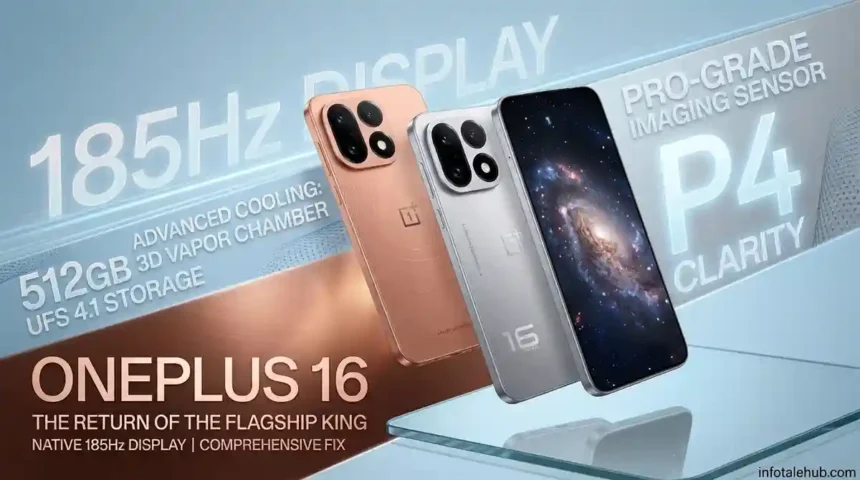
The OnePlus 16 features a massive 6.78-inch BOE X4 OLED display supporting an industry-first 185Hz refresh rate.
- Ultra-Slim 1.15mm Bezels: Bordered by paper-thin 1.15mm symmetrical bezels and protected by Oppo Crystal Shield Glass, the visual immersion is staggering.
- Hardware-Level 1-Nit Low Brightness: Designed for nighttime eye protection, the display achieves true hardware-level 1-nit low brightness without PWM flicker.
Triple Self-Developed Co-Processors
Instead of relying solely on the main SoC, OnePlus equipped the device with three custom silicon chips:
- Self-Developed P4 Display Chip: Handles real-time frame interpolation, motion smoothing, and color accuracy.
- Self-Developed T3 Touch Chip: Completely eliminates touch input lag and micro-stutters.
- Self-Developed Q3 Gaming Network Chip: Ensures ultra-low latency and packet loss prevention during online multiplayer matches.
OnePlus 16 Review Specs: Qualcomm Snapdragon 8 Elite Gen 6 & Monstrous 9000mAh Battery
The hardware sheet of the OnePlus 16 reads like a dream specification list for tech enthusiasts.
+-----------------------------------------------------------------------+
|                       ONEPLUS 16 CORE HARDWARE                        |
+-----------------------------------------------------------------------+
|  Snapdragon 8 Elite Gen 6 SoC  |  R5X Ultra Memory & UFS 4.1 Storage |
+-----------------------------------------------------------------------+
|                 COOLING & POWER ARCHITECTURE                          |
|   * 6428 mm² Glacier VC Cooling  * 9000mAh Oppo Glacier Battery Chip  |
|   * 100W Wired (100% in 55 min)  * 50W Wireless / 27W Reverse Wired    |
+-----------------------------------------------------------------------+
Unmatched Processing Power & Cooling
Under the hood, the device is powered by the Qualcomm Snapdragon 8 Elite Generation 6 SoC, paired with ultra-fast R5X Ultra Memory and UFS 4.1 Storage. To maintain sustained peak clock speeds without thermal throttling, OnePlus integrated a massive 6,428 mm² Glacier Vapor Chamber Cooling System.
Revolutionizing Battery Life: 9000mAh Glacier Battery
In a groundbreaking engineering achievement, OnePlus packed a colossal 9,000mAh Oppo Glacier Battery into a slim body measuring just 8.45mm to 8.5mm in thickness and weighing 217g to 220g.
- 100W SuperVOOC Charging: Recharges the entire 9,000mAh cell to 100% in just 55 minutes.
- Versatile Power Delivery: Supports 50W wireless charging, 27W reverse wired charging, and 5W reverse wireless charging.
Restoring Pro-Grade Photography: 200MP HPE & Periscope Optics
Addressing the camera complaints from reviewers, OnePlus completely overhauled its camera system with pro-grade imaging hardware:
- 200MP Main Camera (Samsung HPE): Features a massive 1/1.4-inch sensor with Optical Image Stabilization (OIS) for hyper-detailed clarity.
- 50MP Periscope Telephoto (Sony LYT-600): Equipped with OIS for crisp optical zoom and portrait compression.
- 50MP Ultra-Wide Camera: Delivers expansive landscape shots with minimal distortion.
- 50MP Front-Facing Selfie Camera: High-resolution front camera for crisp video calling and self-portraits.
Flagship Durability & Premium Connectivity
The OnePlus 16 leaves no checkbox unchecked:
- Quad IP Rating: Quadruple certified with IP66, IP68, IP69, and IP69K water, high-pressure steam, and dust resistance.
- Biometrics & Port: Features a fast 3D Ultrasonic Fingerprint Sensor under the display and a high-speed USB 3.2 Gen 1 port.
Complete Specification Summary
| Feature Category | OnePlus 16 Official Specifications |
| Processor | Qualcomm Snapdragon 8 Elite Generation 6 |
| RAM & Storage | R5X Ultra Memory + UFS 4.1 High-Speed Storage |
| Custom Co-Processors | P4 Display Chip, T3 Touch Chip, Q3 Gaming Network Chip |
| Display | 6.78-inch BOE X4 OLED, 185Hz Refresh Rate, 1.15mm Bezels |
| Battery & Charging | 9000mAh Glacier Battery, 100W Wired, 50W Wireless, 27W Reverse |
| Main Camera | 200MP Samsung HPE (1/1.4″, OIS) |
| Telephoto Camera | 50MP Sony LYT-600 Periscope (OIS) |
| Ultra-Wide & Front | 50MP Ultra-Wide + 50MP Front Selfie Camera |
| Cooling System | 6428 mm² Glacier Vapor Chamber |
| Durability & Sensor | IP66 / IP68 / IP69 / IP69K, 3D Ultrasonic Fingerprint |
| Dimensions & Weight | 8.45mm – 8.5mm thickness | 217g – 220g weight |
Conclusion: The Undisputed King Has Returned (Final OnePlus 16 Review Verdict)
As revealed throughout this in-depth OnePlus 16 review, the official launch proves that when a company listens to its community, swallows its pride, and focuses on deep hardware innovation, it can redefine what a smartphone should be.
By combining the raw power of the Snapdragon 8 Elite Gen 6 with a revolutionary 185Hz BOE display, a massive 9000mAh battery, custom P4/T3/Q3 silicon, and a 200MP camera system, OnePlus has effectively outclassed dedicated gaming phones like RedMagic while remaining a complete, uncompromising daily flagship.
For mobile enthusiasts, shopkeepers, and power-users looking for the ultimate flagship device, official OnePlus global releases have officially brought the “Never Settle” spirit back to life. In this final OnePlus 16 review judgment, the flagship king has officially reclaimed its throne.